
From Cara Krmpotich & Heidi Bohaker, GRASAC Co-Directors
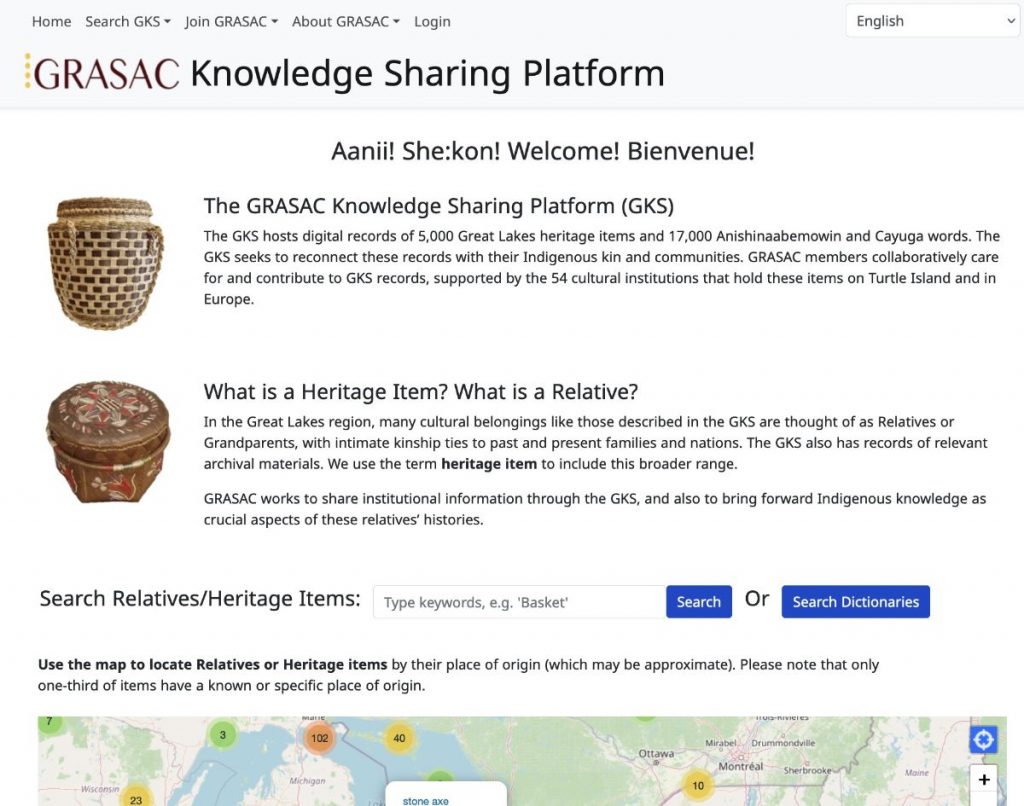
GRASAC’s Knowledge Sharing System, the “GKS,” enters a new phase today as a publicly accessible web platform. Check it out here!
Our new platform answers the call from GRASAC Elders and artists in 2018 to make the work of GRASAC members and partner institutions more accessible to Indigenous youth, artists, language learners and historians.
Community feedback has shaped GRASAC’s approach to “digital reunification” over the last five years. With the new platform, we have taken seriously what it is for communities to meet their relatives and heritage items online. Records forefront connections with Indigenous nations and communities, and we are actively working to improve linkages between heritage items and the Anishinaabemowin and Cayuga dictionaries in the GKS. And, you will notice that you no longer need “seven clicks” to see an image!
One new feature of the GKS is a searchable map that locates heritage items in their place of origin. While we only know the community origin or location of about one-quarter of the cultural belongings described in the GKS, it’s an exciting way to see connections between people and place. We have also looked toward the future and built the site with the ability to function in Anishinaabemowin, Cayuga, and French. We look forward to working with language speakers and linguists toward this end.
We are so grateful for the support of the Faculty of Arts and Science at the University of Toronto, the Faculty of Information and the Department of History, who provided significant funds and technical support to develop and host our new site. Chi-migwetch! Nia:wen! We would also like to acknowledge the hard work over the past five years of graduate and undergraduate student Research Assistants, our developer Vic Tarcenco and the amazing technical and project management leadership of Priya Murugaiah, the Infrastructure Manager for the Faculty of Arts and Science.
Migrating a database as large as the GKS with over 22,000 records(!!) is easier said than done. Over the next few months, we will continue to build in features for GRASAC members such as saved searches and the ability to create folders. We appreciate your feedback as we continue to develop the platform. If you notice any errors or omissions, let us know. We also appreciate your patience: revisiting and revising each heritage item record will take approximately four years. If you have any questions, feedback, or issues with the new site, please send them to us at grasac.pm@utoronto.ca.
The old GKS will continue to be accessible to existing users at https://gks.grasac.org/ for the next 8 months or so, after which it will be archived. However, edits and additions should only be made in the new GKS, as changes to the old site will not be transferred to the new one.
We can’t keep the old GKS online for longer because the software will no longer receive security updates.
We hope the GKS continues to serve you and your communities well, and we thank you for your assistance and patience as we continue to improve it. Stay tuned for more in the coming months!