
From Cara Krmpotich & Heidi Bohaker
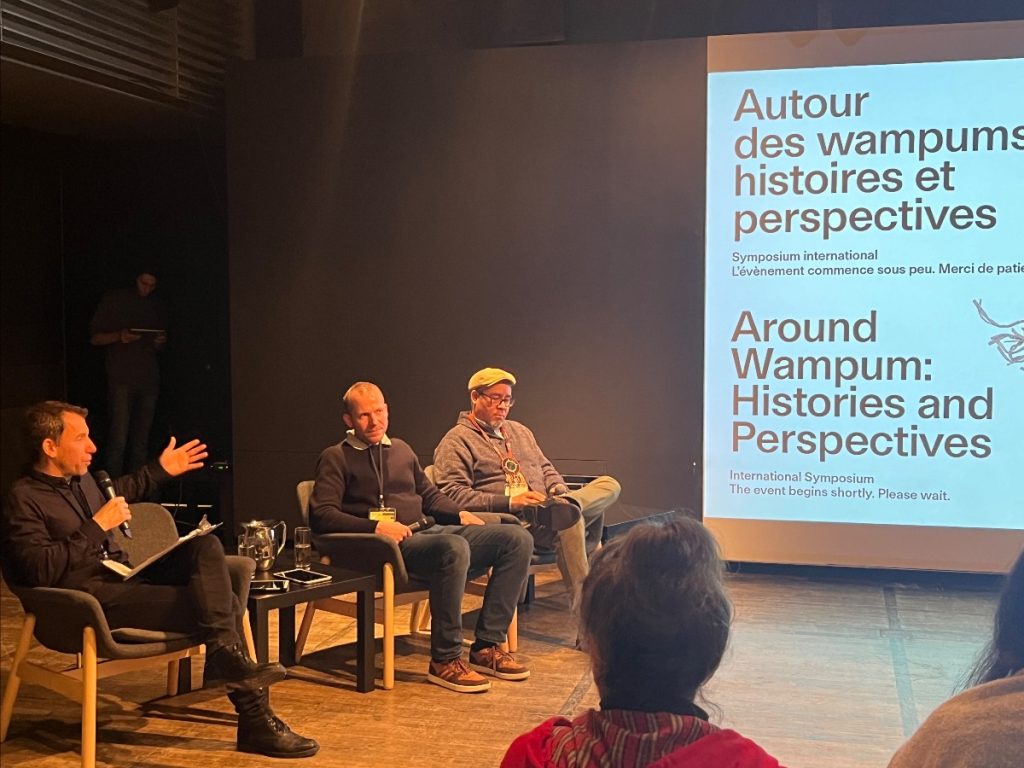
Felicitations, Congratulations, to Jonathan Lainey and the team at the McCord Stewart Museum in Montreal for a highly successful two-day symposium on wampum. The international symposium accompanied the exhibition, Wampum: Beads of Diplomacy, featuring wampum from the Musée du quai Branly – Jacques Chirac in Paris, France, and from private and public collections on Turtle Island. Prior to coming to Montreal, Ganondagan also hosted the belts from the Musée du quai Branly – Jacques Chirac in the exhibition Wampum/Otgoä at the Seneca Art and Culture Center. These wampum were joined by others from the Rochester Museum and Science Center, and contemporary Haudenosaunee artworks.
Over two days, leading wampum scholars gathered to share their understandings of Haudenosaunee, Wendat, Anishinaabeg, and colonially-produced wampum. With 80 people in the auditorium and over 200 people watching online, the speakers presented methodologies for learning from wampum. New interpretations of belts were offered by Rick Hill and Stephen Augustine, and Michael Galban even suggested we think of them more as mats and less as belts. Alan Corbiere provided insights into Anishinaabeg relationships to wampum through linguistic analysis and oral histories. Darren Bonaparte shared the many replicas he has commissioned in his work to understand wampum.
Nikolaus Stolle introduced the audience to lesser-known uses of wampum in historic collections in Europe, and Lise Puyo detailed the creation of wampum to affirm Christian communities across the Atlantic.
Historic and legal scholarship from Elizabeth Elbourne, Heidi Bohaker, Riley Wallace and Jacynthe Ledoux emphasized the tensions between textual records and wampum as historical documents and advocated for the role of wampum in understanding historic and present-day international relations.
Musée du quai Branly – Jacques Chirac collaborator Leandro Varison spoke about how the collaboration with Ganondagan and McCord Stewart Museum has changed understanding and practice at the French museum.
Each day closed with words from Elders: Kanahsohon Kevin Deer and Verna McGregor, emphasizing the on-going importance of wampum, Indigenous governance and relationality, linking past and present.
GRASAC members were out in significant numbers—both in person and online—for this symposium. Time spent learning in the symposium, and visiting with the belts in the exhibition, offered the kind of reunification GRASAC members so appreciate. Stay tuned for information on how to access the recording of the Symposium, thanks to the McCord Stewart Museum.
If you want to see this amazing exhibit in person, you’ll need to hurry. Wampum: Beads of Diplomacy closes March 10, 2024. More information is available here.
